Of all the teachers the Stoics produced, the one who has helped the most ordinary people was born with almost nothing, not even his freedom.
A slave who became a teacher
Epictetus was born around the year 55 in Hierapolis, a town in Phrygia, in what is now south-western Turkey. He came to Rome as a slave. His owner, Epaphroditus, was himself a former slave who had grown rich and powerful in the service of the emperor Nero.
Epictetus was lame, and the ancient sources disagree about why. One story says his master twisted his leg until it broke, while Epictetus calmly warned him that it would. Another blames rheumatism. We don’t know which is true, and that’s worth saying plainly.
What we do know: while still a slave, he studied with the Stoic teacher Musonius Rufus, and he was later freed. Around the year 89, the emperor Domitian banished philosophers from Rome. Epictetus moved to Nicopolis, in north-western Greece, and opened a school there. It drew students from some of Rome’s leading families.
He never wrote a book. A student named Arrian took notes, which became the Discourses (four books survive) and a short handbook of the main ideas, the Enchiridion. The name means something held “in the hand.” A manual. Something to carry.
The sentence everything hangs on
The Enchiridion opens with one line, here in George Long’s translation:
Of things some are in our power, and others are not.
That’s the foundation. Then he sorts the world into two piles. In our power: our opinions, what we move toward, what we desire and what we turn away from. In short, our own judgments and actions. Not in our power: our body, our property, our reputation, our position. In short, whatever is not our own doing.
It sounds almost too simple. Try it on a real day. The train is late. Your boss is in a mood. Someone you love is sick. None of those are up to you. How you meet them is.
Epictetus also warns about what happens when we mix the two piles up. If we treat what belongs to others as our own, he says, we will be hindered, we will lament, we will be disturbed, and we will blame both gods and men. Most of us know that list from experience.
It isn’t the thing, it’s the judgment
A few lines later comes the other idea he is known for. In Long’s version: “Men are disturbed not by the things which happen, but by the opinions about the things.” His example is death. If death were terrible in itself, he says, it would have seemed so to Socrates, who faced it calmly.
This is easy to misread as “nothing should bother you” or “just think positive.” It’s neither. Epictetus isn’t asking us to pretend things are fine. He is asking us to notice the step between what happens and how we take it, because that step is ours. The Greek word he uses for that inner power of choice, prohairesis, is often translated as will, choice or moral purpose. For Epictetus, it is the one thing no one else can own.
Why a slave’s philosophy feels so free
There is something striking about hearing this from someone who was owned by another person. When Epictetus says that our body and our circumstances are not truly ours, he isn’t speaking from comfort. He had less control over his outer life than almost anyone, and still he found something no master could take.
That is part of why his words have travelled so far. An emperor read him: Marcus Aurelius thanks his teacher Rusticus for lending him a copy of Epictetus, and you can hear Epictetus all through the Meditations. People in every kind of hard situation have read him since. The idea is old. The need for it is daily.
Trying it this week
We like philosophy you can practice, so here is an exercise for the week ahead. Once a day, when something bothers you, pause and sort it with two questions:
- Is this up to me?
- If not, which part of my response is?
You won’t always get it right. That’s fine. The sorting is the practice.
So, a question to carry with you: what is one thing you’ve been treating as yours to control that was never up to you?
No email, no account. Signed answers welcome too.
Sources
- Epictetus, The Encheiridion, or Manual, translated by George Long (1877), in The Discourses of Epictetus; with the Encheiridion and Fragments. Wikisource: en.wikisource.org/wiki/Encheiridion_of_Epictetus_(George_Long). Also at Standard Ebooks: standardebooks.org/ebooks/epictetus/short-works/george-long (sections I and V).
- “Epictetus,” Internet Encyclopedia of Philosophy: iep.utm.edu/epictetu (life, school at Nicopolis, Arrian, surviving works, prohairesis).
- Marcus Aurelius, Meditations I.7, translated by George Long, on Rusticus and Epictetus.
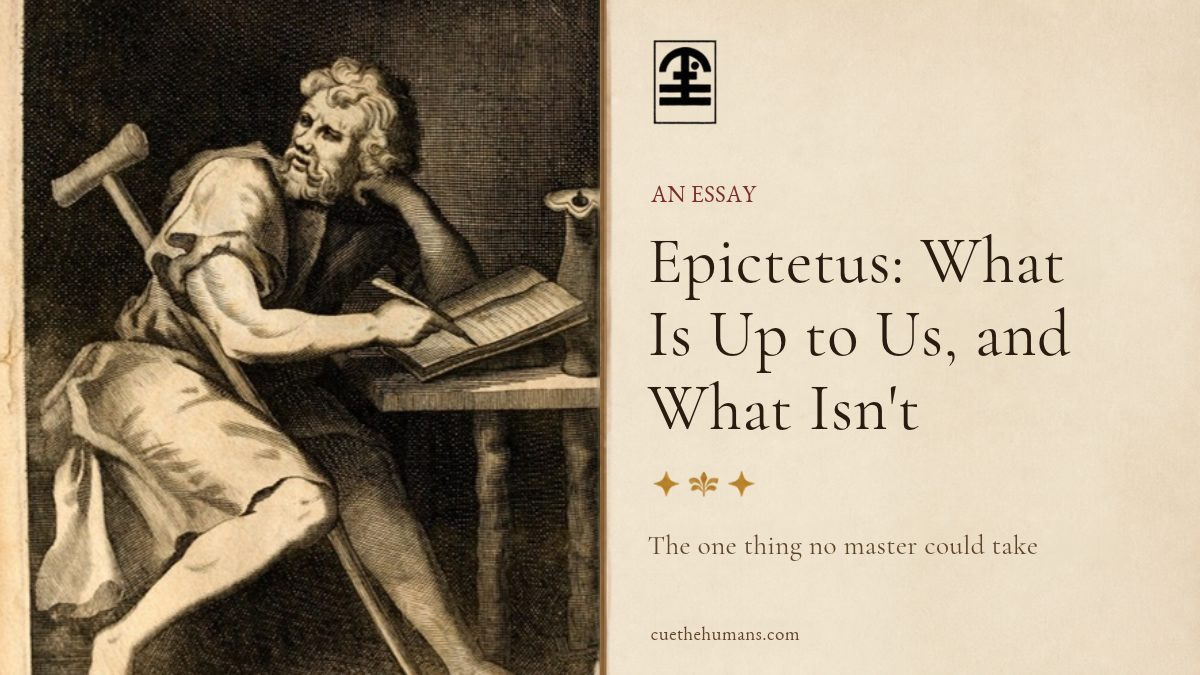
- Featured image: frontispiece of Epicteti Enchiridion (Oxford, 1715), drawn by William Sonmans, engraved by Michael Burghers, public domain, via Wikimedia Commons.