Somewhere on the northern edge of the Roman Empire, in the early 170s, the most powerful man in the world sat down at the end of a long day and wrote a note to himself. He wasn’t drafting a law or a speech. He was reminding himself how to be a decent person tomorrow.
That man was Marcus Aurelius, emperor of Rome from 161 until his death in 180. The notes he kept became the book we now call the Meditations. It is one of the most read works of philosophy in the world, and it was never meant to be read at all.
A book with no audience
The Greek title that has come down to us is ta eis heauton, which means “to himself.” Scholars think the title may have been added later, but it fits. There is no dedication, no introduction, no argument built up chapter by chapter. There are twelve books of short entries, some a single line, some a page long, moving from gratitude to death to the stars to the problem of difficult people.
He wrote in Greek, the language of philosophy in his day, and he wrote, as far as we can tell, while on military campaign in central Europe, roughly between 171 and 175. The second book closes with four plain words: “This in Carnuntum.” Carnuntum was a Roman frontier camp on the Danube, east of present-day Vienna.
Think about that. An emperor at war, in a camp, writing not about strategy but about patience.
What he told himself
The most famous entry opens Book II, in George Long’s translation:
Begin the morning by saying to thyself, I shall meet with the busybody, the ungrateful, arrogant, deceitful, envious, unsocial.
This is not a man who expects the day to go well. He expects to be annoyed. What he does next is the interesting part. He reminds himself that these people act out of ignorance of what is good and bad, that they share the same reason he does, and that we were made to work together, like hands and feet, not against each other. He isn’t telling himself to feel nothing. He is preparing.
Book IV has another line people carry around: “The universe is transformation: life is opinion.” In a few words he names the two things the Stoics practiced for a lifetime: accepting that everything changes, and noticing that how we judge a thing shapes how it feels.
In the same book he writes about the urge to get away from it all. People, he says, look for retreats in the country, by the sea, in the mountains. But “it is in thy power whenever thou shalt choose to retire into thyself.” The retreat he wants isn’t a place. It’s a habit of mind.
Why a private notebook matters
Here is what makes the Meditations different from almost every other classic. It isn’t trying to win an argument. It’s trying to remind.
Most philosophy is written to persuade someone else. Marcus is writing to someone who already agrees and still keeps forgetting: himself. That’s why he repeats himself. That’s why some entries sound like a coach talking to a tired player. He returns again and again to the same few ideas, because he knew, as we all do, that knowing something and living it are not the same.
It also explains the honesty. Book I is simply a list of thanks: to his grandfather, his mother, his teachers, the man who adopted him. One teacher, Rusticus, lent him a copy of the discourses of Epictetus, a former slave who became a Stoic teacher. That one loan shaped the book that followed. We’ll meet Epictetus in our next essay.
How it survived
A notebook like this could easily have vanished. The first recorded mention of it comes in 364, almost two centuries after Marcus died. The text we read today comes down mainly through a manuscript in the Vatican and another that has since been lost, and it was first printed in 1558. Somewhere along the way, a lot of people decided these private notes were worth copying.
A commonplace book, long before ours
We call Cue The Humans a commonplace book for curious humans, and the Meditations is a big part of why that idea feels right to us. A commonplace book is where you write down what you don’t want to forget: a line you read, a lesson learned the hard way, a question you keep circling. It isn’t polished. It’s useful.
That’s why it is the first book our circle is reading this winter. Not because Marcus had it all figured out. Because he plainly didn’t, and he kept trying anyway, one note at a time.
So here is a small invitation. Tonight, before bed, write one line to yourself that you’ll need tomorrow morning. Not advice for the world. Advice for you.
What would your line say?
No email, no account. Signed answers welcome too.
Sources
- Marcus Aurelius, Meditations, translated by George Long. Standard Ebooks: standardebooks.org/ebooks/marcus-aurelius/meditations/george-long (Book I.7 on Rusticus; Book II, opening and closing lines; Book IV.3).
- “Marcus Aurelius,” Internet Encyclopedia of Philosophy: iep.utm.edu/marcus (dates, title, place and time of writing, manuscript history).
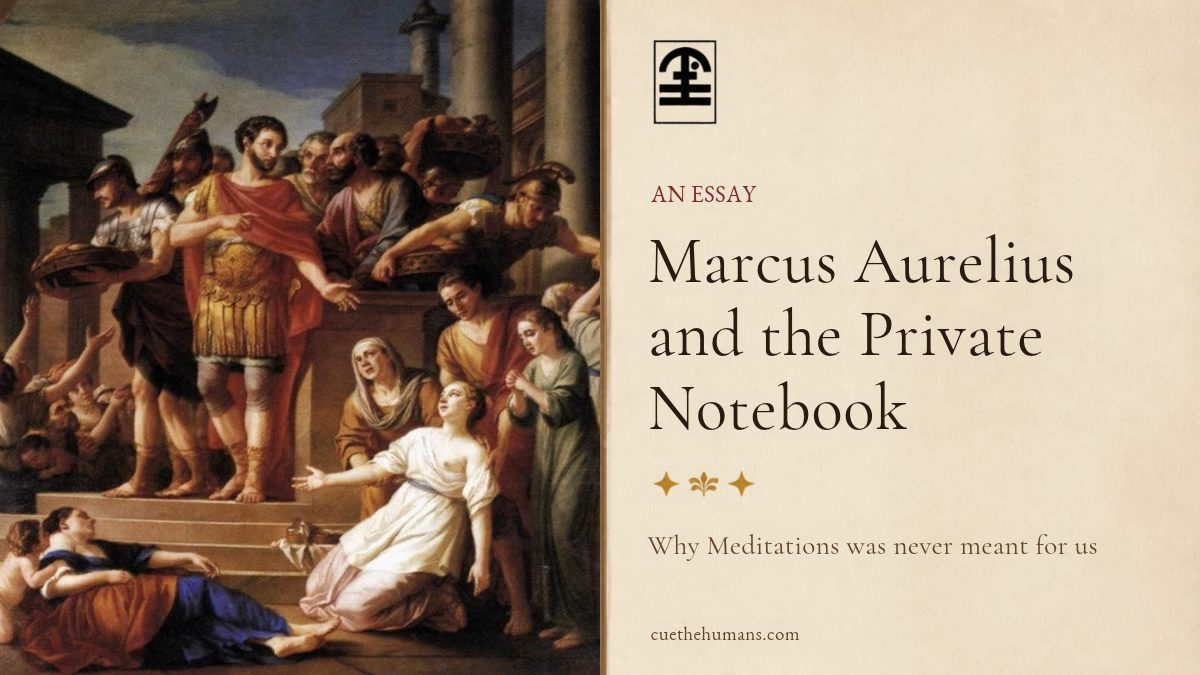
- Featured image: Joseph-Marie Vien, Marcus Aurelius Distributing Bread to the People (1765), public domain, via Wikimedia Commons.